How to Stay Invested Through Market Volatility
26 September 2026
Market declines are unpleasant. They are also inevitable. Every investor who has spent meaningful time in public markets has watched a portfolio lose value in a matter of weeks, sometimes days. The question that separates long-term wealth builders from those who repeatedly buy high and sell low is not whether they feel fear during a downturn. They do. The question is what they do with that fear.
Staying invested through volatility sounds simple. In practice, it requires a combination of preparation, understanding, and behavioral discipline that most people never fully develop. This article explains the mechanics behind why staying invested works, when the standard advice needs adjusting, and how to build a portfolio and a mindset that can survive the worst the market throws at it.

Why Volatility Feels Like a Crisis When It Is Not
Human beings are pattern-seeking animals wired to respond to immediate threats. A falling portfolio balance triggers the same psychological alarm as a physical danger. The problem is that this alarm system evolved for short-term survival, not for thirty-year retirement planning. It treats a temporary drawdown as a permanent loss.There is a real mathematical reason losses hurt more than gains feel good. A portfolio that drops 20 percent needs a 25 percent gain to break even. A 50 percent drop requires a 100 percent recovery. This asymmetry explains why investors feel such urgency to "do something" when markets fall. The pain is disproportionate, and the instinct to stop the bleeding is powerful.
But here is the critical distinction. A paper loss is not a realized loss until you sell. The investor who holds through a decline still owns the same number of shares. The business earnings, dividends, and long-term compounding potential of those holdings have not disappeared simply because the quoted price moved. Selling converts a temporary markdown into a permanent capital impairment.

The Historical Case for Patience
Markets have experienced severe declines many times. The 2008 financial crisis cut major equity indexes roughly in half. The 2020 pandemic crash happened faster than almost any decline in modern history. The 2000 to 2002 dot-com collapse punished technology-heavy portfolios for years. In each case, investors who sold near the bottom locked in devastating losses. Investors who held, and especially those who kept contributing, recovered and eventually prospered.The reason is straightforward. Public equity markets represent ownership in productive businesses. Over long periods, those businesses tend to grow earnings, and share prices follow earnings. Recessions, panics, and credit crises interrupt that growth but rarely end it. The market has always eventually recovered because economies adapt, innovate, and expand.
That said, "always eventually" is doing important work in that sentence. Recovery timelines vary dramatically. Some declines recover within months. Others, like the aftermath of the 2008 crisis, took years for broad indexes to return to prior highs. Investors nearing retirement in 2008 faced a genuinely difficult situation. This is why staying invested is not a universal prescription. It is a strategy that works when paired with the right time horizon and the right portfolio structure.

Match Your Time Horizon to Your Risk
The single most important factor in whether you can stay invested is when you need the money. Money you will need in one or two years should not be in volatile assets, because a market decline at the wrong moment could force you to sell at a loss. Money you will not touch for twenty years can tolerate far more volatility, because there is ample time for recovery.This principle is called matching assets to liabilities. A retiree drawing income from a portfolio needs a different structure than a thirty-five-year-old contributing to a retirement account. The retiree may need several years of spending held in stable assets so that a market decline does not force the sale of equities at depressed prices. The younger investor can afford to hold mostly equities because there is no near-term withdrawal requirement.
Many investors get this backwards. They take too little risk when they are young, when time is their greatest asset, and too much risk when they are close to retirement, when they can least afford a severe drawdown. Correcting this mismatch is one of the most valuable things you can do before the next downturn arrives.
Build a Portfolio You Can Actually Hold
The best portfolio is not the one with the highest theoretical return. It is the one you can stick with through a bear market without panic selling. This is a crucial and often overlooked point. A slightly more conservative allocation that you hold for thirty years will almost certainly beat an aggressive allocation that you abandon during the first crisis.Consider two investors. The first holds a 90 percent equity portfolio and sells everything in a panic during a 40 percent decline. The second holds a 70 percent equity portfolio and rides the same decline to the bottom without selling. The second investor ends up far ahead, despite holding a "less optimal" allocation on paper.
This is why risk tolerance is not just a questionnaire you fill out at your brokerage. It is a behavioral reality you must test honestly. If a 30 percent portfolio decline would keep you up at night, you should not hold an allocation that makes that outcome likely. The cost of a more conservative portfolio is lower expected returns. The benefit is that you actually capture those returns because you never sell in a panic.
The Role of Cash and Short-Term Reserves
One of the most effective ways to stay invested in your long-term portfolio is to keep adequate cash reserves outside of it. When you have an emergency fund covering six to twelve months of expenses, a market decline does not threaten your ability to pay bills. You are not forced to sell investments at a loss to cover a car repair or a layoff.This separation matters psychologically as well as financially. Knowing that your near-term needs are covered makes it far easier to leave your long-term investments alone. The cash reserve is not a drag on returns. It is insurance that protects your ability to stay invested.
Retirees should think in terms of a cash and bond ladder covering several years of withdrawals. This structure means that even if equities fall sharply, the retiree can continue funding living expenses from stable assets while waiting for the recovery. The sequence of returns risk, which is the danger of experiencing poor returns early in retirement, is substantially reduced by this approach.
Rebalancing as a Discipline, Not a Prediction
Rebalancing is the practice of periodically adjusting your portfolio back to your target allocation. If equities have risen and now represent a larger share than intended, you sell some equities and buy bonds. If equities have fallen, you sell bonds and buy equities. This mechanically forces you to sell high and buy low without requiring any forecast about the future.During market declines, rebalancing is one of the few actions that is both emotionally difficult and financially sound. Buying more equities when prices are falling feels wrong. But it is precisely what disciplined investors do, and it is how they recover faster than those who sit frozen or sell.
There are trade-offs. Rebalancing too frequently creates unnecessary transaction costs and potential tax consequences in taxable accounts. Rebalancing too rarely allows your allocation to drift far from your target. A common approach is to check allocations quarterly or semi-annually and rebalance only when an asset class deviates by a meaningful threshold, such as five percentage points from its target. This balances discipline against cost.
In tax-advantaged accounts, rebalancing has no immediate tax cost, so it can be done more freely. In taxable accounts, it is often better to rebalance using new contributions or by directing dividends and interest to underweight asset classes rather than selling appreciated positions.
Common Mistakes That Break the Strategy
Even investors who understand the logic of staying invested make predictable errors that undermine their results.The first is checking portfolio values too often. Research on investor behavior consistently shows that frequent monitoring increases anxiety and the likelihood of impulsive decisions. Daily price checking provides no actionable information for a long-term investor and exposes you to a constant stream of alarming headlines. Checking monthly or quarterly is plenty for most people.
The second mistake is confusing volatility with risk. Volatility is the short-term fluctuation of prices. Risk is the permanent loss of capital or the failure to meet your financial goals. A stock that swings wildly but recovers is volatile. A stock in a company that goes bankrupt is a permanent loss. These are different things, and treating all volatility as risk leads to excessive caution and missed returns.
The third mistake is acting on financial media. Television and online financial news are built to generate attention, and fear generates more attention than calm. Headlines during downturns are designed to alarm. Investors who make decisions based on this coverage tend to sell at the worst possible moments.
The fourth mistake is failing to distinguish between a market decline and a change in your personal circumstances. If your job is secure and your goals are unchanged, a market decline is not a reason to change your investment strategy. If your circumstances have genuinely changed, such as a job loss or a health crisis, then adjusting your portfolio may be appropriate. The key is to separate external noise from genuine changes in your own situation.
When Staying Invested Is Not the Right Answer
Intellectual honesty requires acknowledging that "just stay invested" is not always correct. There are situations where reducing risk or selling is the right decision.If you are holding individual stocks in companies whose competitive position has permanently deteriorated, holding through a decline is not patience. It is denial. The same applies to sectors facing structural decline. Index investors avoid this problem because broad indexes replace failing companies with growing ones over time. Individual stock pickers must be willing to admit mistakes and move on.
If your time horizon has shortened unexpectedly, perhaps due to a health diagnosis or a change in retirement plans, reducing equity exposure may be prudent. If your risk tolerance has genuinely changed, ignoring that reality is not discipline. It is stubbornness.
The distinction is this. Selling because the market is falling is almost always a mistake. Selling because your circumstances or the fundamentals of a specific investment have changed can be entirely rational. The challenge is being honest with yourself about which situation you are in.
Practical Steps to Prepare Before the Next Downturn
Preparation happens before the storm, not during it. Investors who have a written plan and a clear rationale for their allocation are far more likely to hold steady when markets fall.Write down your investment policy. Include your target allocation, your rebalancing rules, and the conditions under which you would change your strategy. Having this in writing makes it harder to rationalize an emotional decision later.
Automate your contributions. Regular investing through payroll deductions or automatic transfers removes the temptation to time the market and ensures you keep buying during declines.
Set a rule for yourself about financial news. Many successful long-term investors simply stop watching financial television and limit their news consumption during downturns. This is not ignorance. It is protecting your decision-making from information that is designed to provoke rather than inform.
Prepare a response to your own worst instincts. Write down what you will do if the market falls 30 percent. Decide now, while you are calm, that you will rebalance, continue contributing, and not sell. Having a pre-commitment makes it far easier to follow through when the moment arrives.
The Compounding Cost of Getting It Wrong
The reason this topic matters so much is that the cost of panic selling is enormous and often irreversible. Missing just a handful of the market's best days, which often occur immediately after the worst days, can dramatically reduce long-term returns. Investors who sell during a decline frequently wait for "clarity" before returning, and by the time they feel safe, much of the recovery has already happened.This is the cruel irony of market timing. The moments that feel safest to buy are usually the most expensive. The moments that feel most dangerous are often the best opportunities. Investors who can tolerate discomfort and stay invested are rewarded for that tolerance.
A Final Perspective
Staying invested through volatility is not about suppressing emotion or pretending declines do not hurt. It is about building a structure, both financial and psychological, that allows you to make good decisions when your instincts are screaming at you to do the opposite. It is about understanding that volatility is the price of admission for long-term returns, and that the investors who succeed are not the ones who avoid the storms but the ones who are still standing when the weather clears.The market will fall again. It always does. The question is whether you will be prepared to do nothing, or whether you will join the ranks of investors who sell at the bottom and wonder, years later, why their returns never matched the market's.
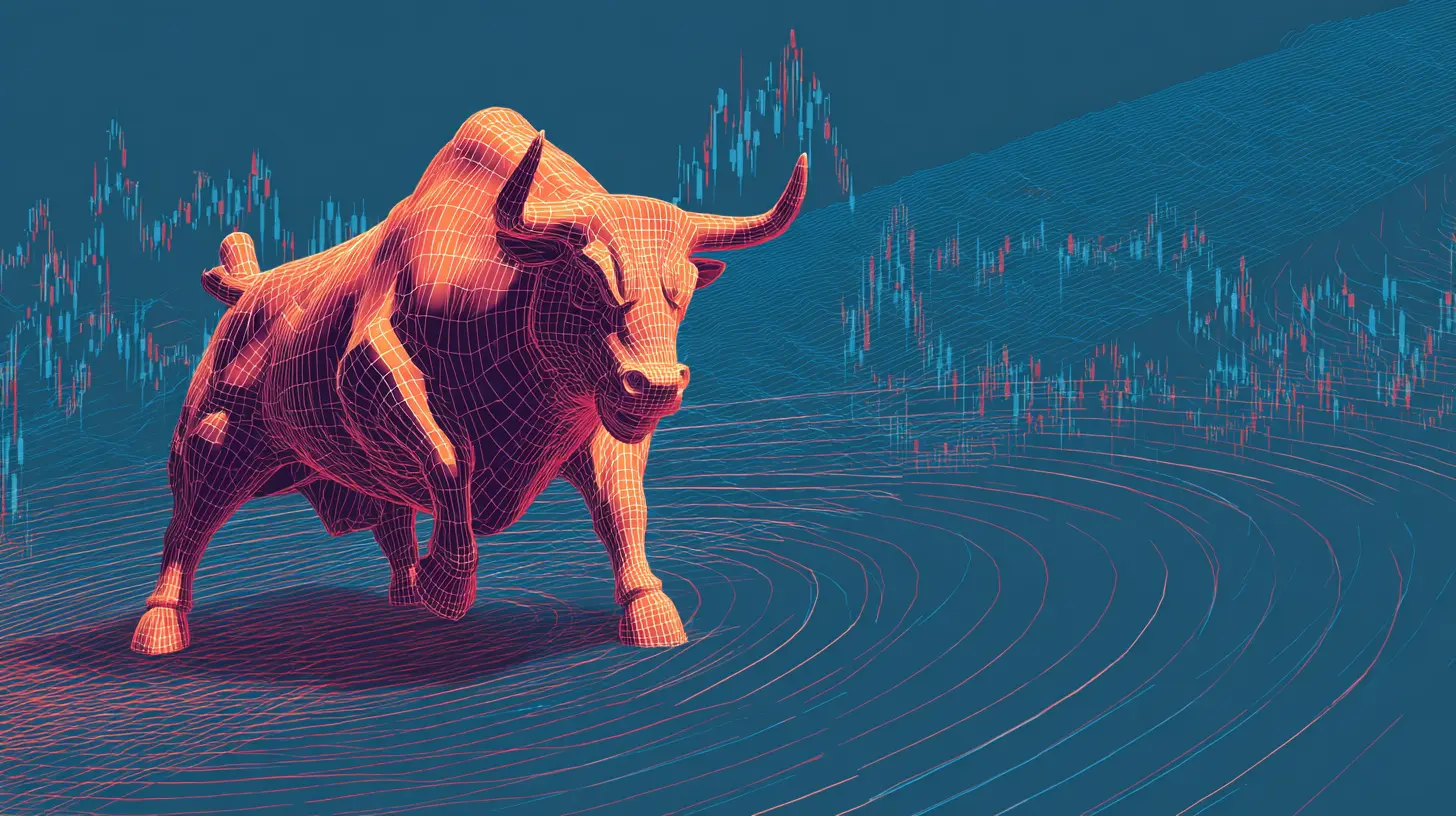
all images in this post were generated using AI tools
Category:
Long Term InvestingAuthor:

Zavier Larsen