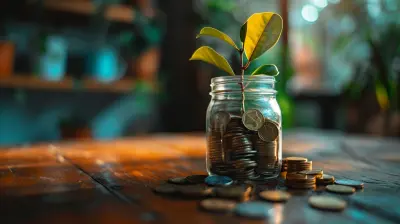
Understanding Compound Interest: The Key to Growing Your Wealth
7 June 2026
Alright, let’s crack open one of the most powerful money secrets out there—compound interest. Sounds fancy, right? But believe me, once you get the hang of it, you’ll wonder why this life-altering concept wasn't emphasized in school. If you've ever heard the phrase, "Make your money work for you," this is what they were talking about.
Whether you're just starting your financial journey or you're a seasoned saver looking to optimize your investments, understanding compound interest can seriously change the game. Let’s break it down together.
What Is Compound Interest?
Let’s start with the basics. Compound interest is the interest you earn on both the money you’ve saved (your principal) and the interest you’ve already earned. Yep, your interest earns interest. It’s like a snowball rolling down a hill—by the time it gets to the bottom, it’s way bigger than when it started.Here’s a bite-sized comparison:
- Simple interest gives you interest only on your original investment.
- Compound interest gives you interest on your investment and interest on the interest over time.
And that’s where the magic happens.
Why Is Compound Interest So Powerful?
Albert Einstein (yes, that Einstein) once called compound interest the “eighth wonder of the world.” And for good reason. It turns small, consistent savings into massive wealth over time.Think of compound interest like planting a tree. Initially, it’s just a seed, but with water, sunlight, and time, it grows into something huge. You don’t need to plant a forest overnight. Just start with one tree, nurture it, and let nature do its thing.
The Formula Behind Compound Interest (Don't Worry, It's Easy)
Alright, we’re going to get a tad mathy here—but stick with me, it’s not bad.The formula for compound interest is:
A = P(1 + r/n)^(nt)
Where:
- A = the future value of the investment
- P = the starting amount (the principal)
- r = annual interest rate (as a decimal)
- n = number of times interest is compounded per year
- t = number of years the money is invested
Let’s say you invest $1,000 at a 5% annual interest rate, compounded annually, for 10 years:
A = 1000(1 + 0.05/1)^(1×10) = 1,000(1.05)^10 ≈ $1,628.89
You didn’t do anything except let your money sit there, and it’s now worth $628.89 more. That’s the beauty of time and compound interest working together.
Time: Compound Interest’s Best Friend
Here’s the kicker—the earlier you start, the more you’ll earn. Time is your best friend when it comes to growing your wealth through compounding.Let’s look at two friends:
- Sam starts investing $200 a month at age 25 and stops at 35.
- Alex starts at 35 and invests $200 a month until 65.
Even though Alex invested for 30 years (three times longer than Sam), Sam will likely end up with more money at 65. Why? Because Sam let compound interest work for an extra 10 years at the beginning—when it mattered most.
Mind-blowing, right?
Frequency Matters Too
How often your interest is compounded can also make a difference. It could be:- Annually
- Semi-annually
- Quarterly
- Monthly
- Daily
The more frequently it compounds, the quicker your investment grows. Think of it as getting mini power boosts throughout the year.
Monthly or daily compounding might not seem like a big deal at first glance, but over decades, the differences can be significant.
Real-World Applications of Compound Interest
Let’s step out of the textbook and into real life. Where can you find compound interest working its magic?1. Savings Accounts
Good ol’ savings accounts use compound interest. The rates are pretty low, especially in traditional banks, but credit unions and high-yield savings accounts might offer better options.2. Retirement Accounts (401(k)s, IRAs, Roth IRAs)
These are golden. They often include employer matching and grow tax-deferred or tax-free. With compounding in your corner, even modest monthly contributions can snowball into seven figures over time.3. Investments
Stocks, index funds, mutual funds—these are the true playgrounds for compound interest. Reinvesting your dividends increases your principal, which earns more money over time.4. Debt (Yes, It Works Against You Too)
Unfortunately, it works both ways. Compound interest is also the reason credit card debt spirals out of control quickly. If you’re not paying off your balance, your debt snowballs faster than you can say “minimum payment.”The Rule of 72: A Quick Compounding Hack
Want to estimate how long it’ll take for your money to double?Use the Rule of 72. Just divide 72 by your interest rate.
For example, with an interest rate of 8%, your money will double in about:
72 ÷ 8 = 9 years
This isn’t exact science, but it’s a handy mental shortcut.
How to Maximize Compound Interest
Ready to let your money grow like magic beans? Here’s how to make the most out of compound interest:1. Start Early
Even if you're just saving $50 a month, starting in your 20s beats $500 a month in your 40s. Time always wins.2. Be Consistent
Set it and forget it. Automate your savings or investments so you don't have to think about it. Think of it like brushing your teeth—just part of your routine.3. Reinvest Earnings
Whether it’s dividends or interest from bonds—put that money back in. That’s how compounding picks up speed.4. Avoid Debt
On the flip side, compound interest can quickly rack up if you have high-interest debts like credit cards. Pay them off ASAP and keep them in check.5. Increase Contributions Over Time
As your income grows, bump up your savings. Even an extra $20 a week adds up over decades.Compound Interest in Reverse: The Retirement Advantage
It’s crazy how many people underestimate what just a few decades of compounding can do.Let’s say you start investing at age 25 and put away $300 a month in an account that earns 7% annually. By retirement at age 65, you’d have over $760,000.
Now imagine bumping it up to $500 a month—you’re looking at over $1.27 million.
It’s not about striking it rich overnight—it’s about building wealth slowly and steadily. That’s the kind of millionaire most people don’t even notice walking down the street.
The Emotional Side of Saving
Here’s the truth—compound interest is boring at first. You won’t see big results for a while, and that can test your patience. But think of it like planting a garden: you water the soil for months with just a few sprouts before things really take off.The trick? Stay the course. Watch your money grow slowly over time and avoid the temptation to dip into it for random luxuries. Your future self will be high-fiving you.
Busting Common Myths About Compound Interest
Let’s deal with a few myths floating around:❌ "You need a lot of money to start investing"
Nope. Start with what you have. Even $10 in a high-yield savings account can start earning interest today.❌ "It’s too late for me"
It’s never too late. Sure, earlier is better, but even in your 40s or 50s, compound interest can still work wonders—just adjust your strategy and invest smartly.❌ "Compound interest only applies to savings accounts"
Wrong again. It applies to any investment where your returns can be reinvested—stocks, bonds, retirement funds, you name it.Final Thoughts: Compound Interest is Your Wealth-Building Superpower
If there’s one takeaway here, it’s this: compound interest isn’t just a financial concept—it’s a mindset. It rewards patience, consistency, and smart decisions. No shortcuts. No gimmicks.Get started, stay the course, and let time and interest do the heavy lifting. Even if you’re not a math whiz, understanding this one principle could be the difference between just getting by and living with financial freedom.
So, start planting those seeds today. Your future self will thank you—probably from a beach somewhere.
all images in this post were generated using AI tools
Category:
Financial EducationAuthor:

Zavier Larsen
Discussion
rate this article
1 comments
Jacqueline Perry
This article breaks down compound interest in a way that's easy to grasp. Understanding its power can truly transform your financial journey. Thanks for shedding light on such an essential concept for anyone looking to build their wealth.
June 26, 2026 at 10:45 AM
Zavier Larsen
Thank you for your kind words! I'm glad the article helped clarify compound interest and its impact on wealth building.